Purpose
The purpose of this Business Process Procedure is to explain how to complete an appointment change action in the Integrated HR-Payroll System.
Trigger
There is a need to process an Appointment Change action for one of the reasons listed in the Business Process Procedure Overview section.
Business Process Procedure Overview
An appointment change is defined as the change in the employee’s type of appointment. Examples include, but are not limited to:
- Permanent
- Probation
- Time-limited
- Time-limited probationary
Note: Employee is not changing position numbers.
An Appointment Change occurs when an employee has successfully completed his or her probationary period and receives an appointment to either a permanent or a time-limited position. Based upon the supervisor‘s recommendation, the employee may transition from probationary status at two (2) years. In order for the employee to receive an increase in salary, an Appointment Change Action (rather than a Salary Adjustment Action) must be used. This is because the employee subgroup must be changed. When you create an Appointment Change, not all infotypes that display will require that you change information. Your agency, as well as the type of appointment change, determines this.
Reasons:
- (08) Supplemental to Probation - Employee is changing from Temporary status to a Probationary status, within the same position, but the employee must serve a probationary period.
- (09) Supplemental to Permanent - Employee is changing from a Temporary status to a Permanent status, within the same position, in which the employment in the Temporary position satisfies the probation period and credentials have been verified.
- (11) Probation to Permanent - Employee has completed the probationary period.
- (03) Probation/Time-Limited to Time-Limited - Employee has completed the probationary time-limited period.
- (02) Time-Limited to Permanent - Employee has exceeded 36 months of employment or position is being made permanent.
- (22) Time-Limited to Probation - Employee is changing from time-limited status to probationary status within the same position.
- (04) Part-Time to Full-Time - Employee hours will be 40.
- (05) Full-Time to Part-Time - Employee hours will be less than 40.
- (06) Change in Hours - Part-time hours changing
- (07) Extension of Appointment - (No money involved)
- (10) Intermittent to Probation - Employee status that requires a probationary period
- (12) Permanent to Time-Limited - Employee status that is time-limited
- (13) Permanent to Supplemental - Employee status that is Temporary
- (14) Permanent to Intermittent - Employee status that is Intermittent
- (15) Change in FLSA – Employee overtime eligibility status (FLSA) is changing.
- (20) Supplemental to Time-Limited - Employee is changing from Temporary status to a Time-Limited status.
- (21) Supplemental to Probation TL - Employee is changing from Temporary status to Probation Time-Limited status.
Access Transaction
Via Transaction Code: ZPAA076
Action Request Procedure
There are 45 steps to complete this process.
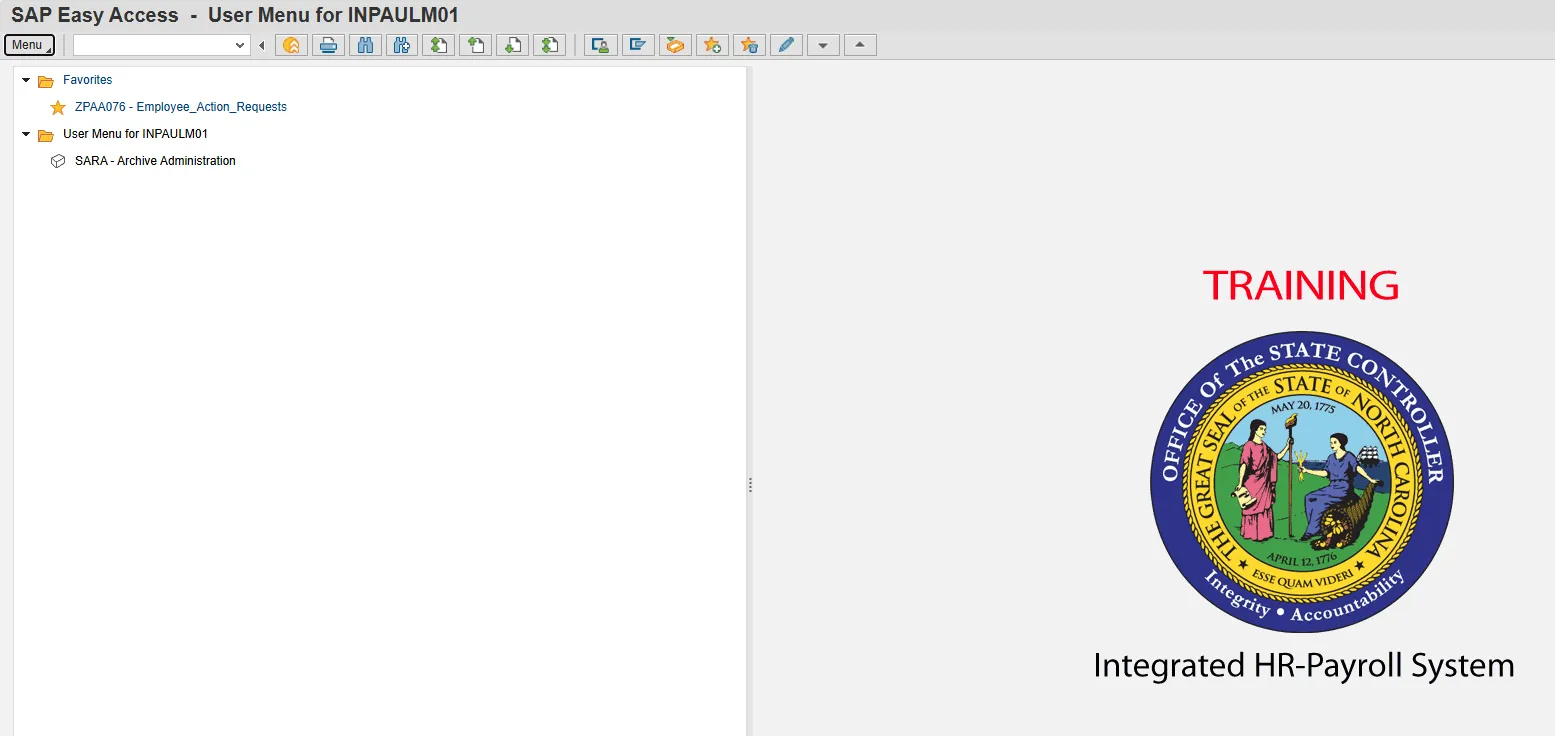
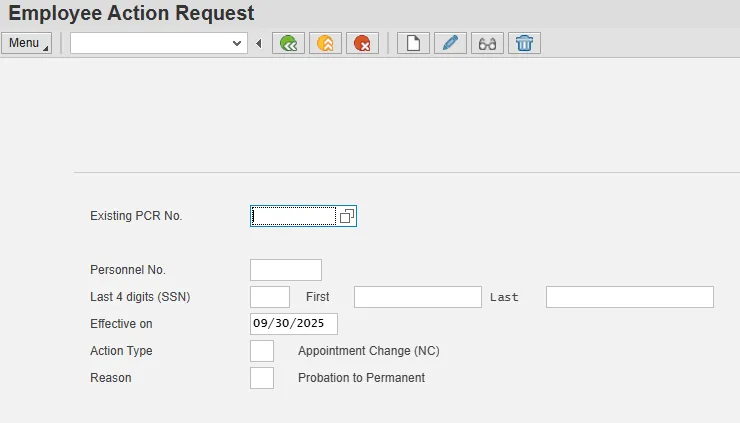
Step 1: Type ZPAA076 in the Command field and click Enter OR double-click ZPAA076 from favorites.
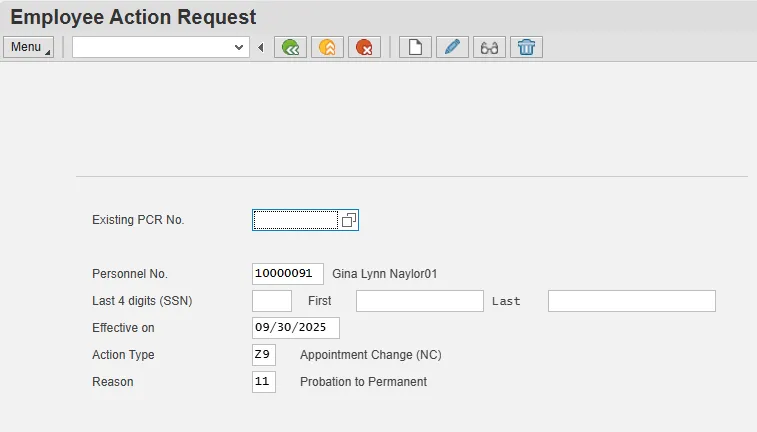
Step 2: Update the following fields:
| Field Name | Description | Values |
|---|---|---|
| Personnel No. | Unique employee identifier |
Enter value in Personnel No. Example: 10000091 |
| Effective on | The date on which the action will be effective |
Enter value in Effective on. Example: 09/30/2025 |
| Action Type | An action is a grouping of activities to perform a specific task. The action will prompt you for the Infotypes required to complete the task. |
Enter value in Action Type. Example: Z9 |
| Reason | Reason for the action, such as Probation to Permanent |
Enter value in Reason. Example: 11 |
Step 3: Click Enter.
Enter the Personnel Number of the individual on which the Appointment Change is be processed. Click Enter to retrieve the name of the individual and verify you have the correct Personnel Number.
If you need to look up the personnel number, click your cursor in the field and click on the matchcode search button to the right of the field for search options.
The system defaults the current date, but you may change the date to a day in the past or in the future. OSHR approval is required for Actions that exceed 60 days in the past.
There are several available Reasons to choose from. For specific information on each reason, view the business process overview section at the beginning of these instructions.
Click Enter to verify the information is correct before proceeding.
Step 4: Click the Create (F5) button.
If the information is correct, click Create to begin the process.
Leave the Existing PCR No. field blank if you are creating a new PCR.
Several fields on this screen are mandatory. The system will not let you continue if you have not provided data for the mandatory fields. If you are unsure which fields are mandatory, click Enter, and the system will prompt you for information in the mandatory fields.
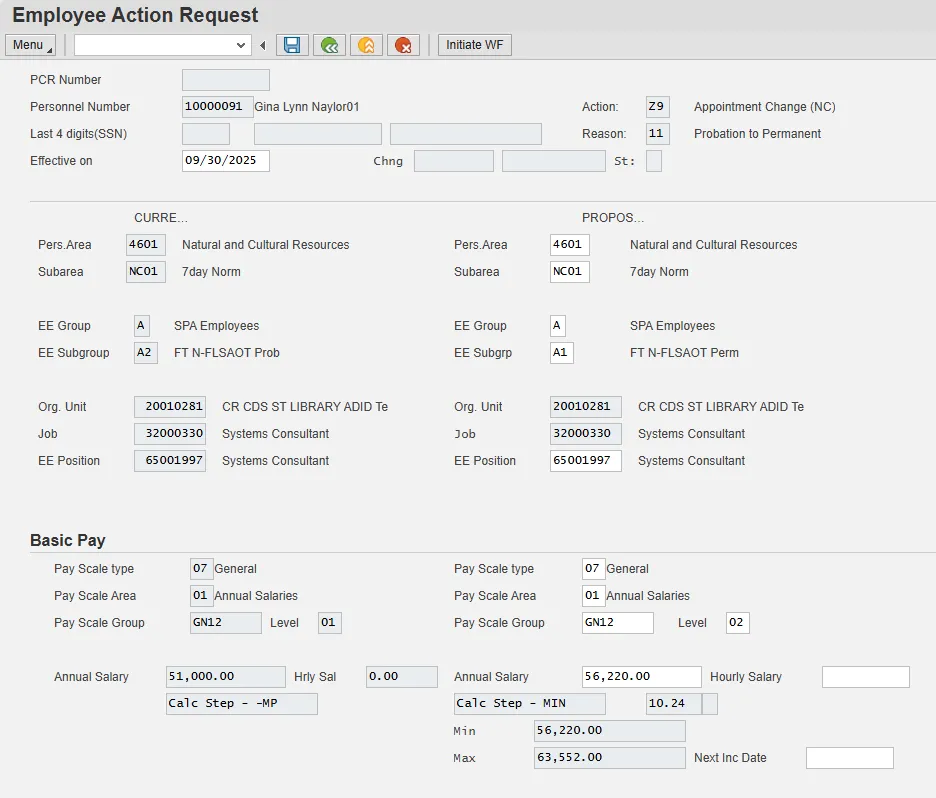
Step 5: Update the following fields:
| Field Name | Description | Values |
|---|---|---|
| EE Subgrp | Employee’s type of appointment |
Enter value in EE Subgrp Example: A1 |
| Annual Salary | Employee’s annual basic pay |
Enter value in Annual Salary. Example: 56220 |
Step 6: Click Enter.
Enter the salary/hourly information in the Annual Salary or Hourly Salary field. Clicking Enter will allow you to validate the data.
Be sure to check the Level field. It is related to the Annual Salary field and based on a salary range. Click on the matchcode to see the salary ranges.
If the employee is an hourly employee, you will have to enter the hourly amount. The annual amount doesn’t populate for hourly/salary employees. The system will calculate on IT0008 Basic Pay when created.
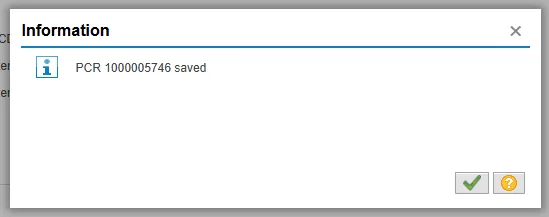
You can save this information as many times as you like. Each time you will receive a confirmation of the save. You will not be able to create a note attachment until you have saved it at least once. If you have already submitted the PCR to workflow, you will not be able to change the details, nor save any new information, only display the existing details.
Step 7: Click Enter.
Step 8: Click the Save (Ctrl+S) button.
Review the data prior to saving. If the data is correct, click Save.
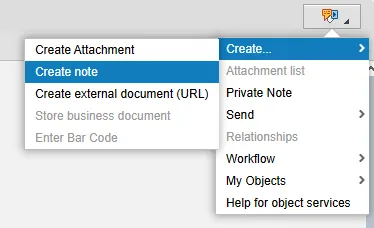
Step 9: Click the Services for Objects button.
Step 10: Click Create... >> Create note.
You can enter any information that would be useful to the approvers downstream using the notes area or attachment area. If you just need to type some information in, or copy and paste from an email, it may be beneficial to create a note. If you want to add a document as an attachment, use the attachment area.
This note and attachment area gets attached only to this specific PCR. It will follow the PCR through the approval/rejection process and live with the PCR into the future. When the PCR has been approved, and you are processing the Action (such as a New Hire action), you will need to recreate any notes or attachments if they need to be attached to the Action record as well.
Notes entered during PA Workflow must follow OSHR’s Action Notes Template.
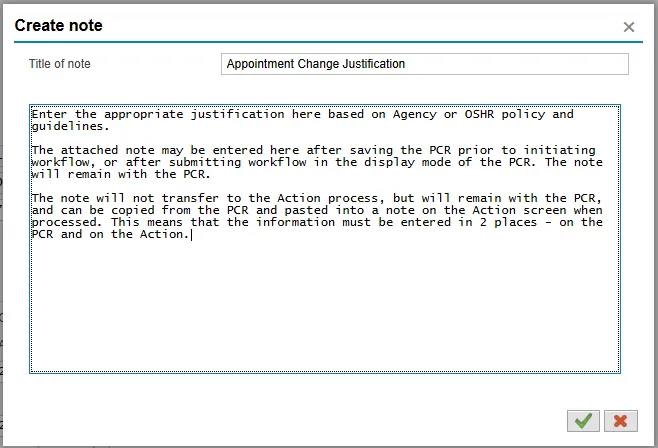
Step 11: Update the following fields:
| Field Name | Description | Values |
|---|---|---|
| Title of note | The short text to act as the title of the attachment |
Enter value in Title of note. Example: Appointment Change Justification |
| Long text | An open text field |
Long text An open text field Enter value in long text. Example: appropriate information |
Step 12: Click Enter or the green check.
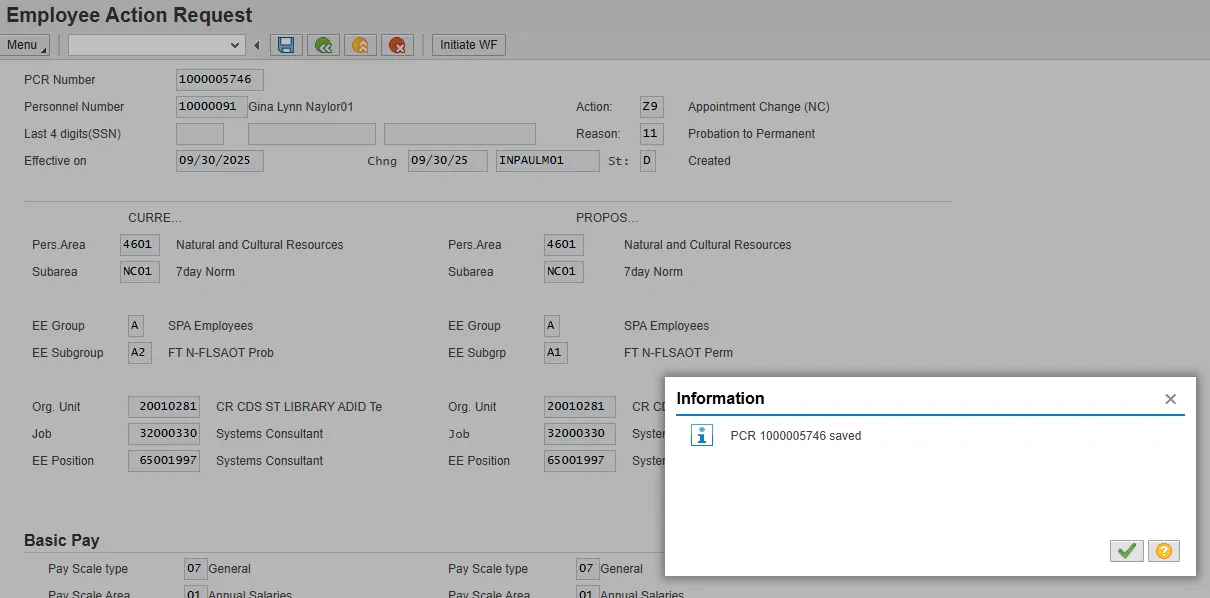
Step 13: Click Save to ensure the note is attached to the PCR.
Step 14: Click Enter or the green check.
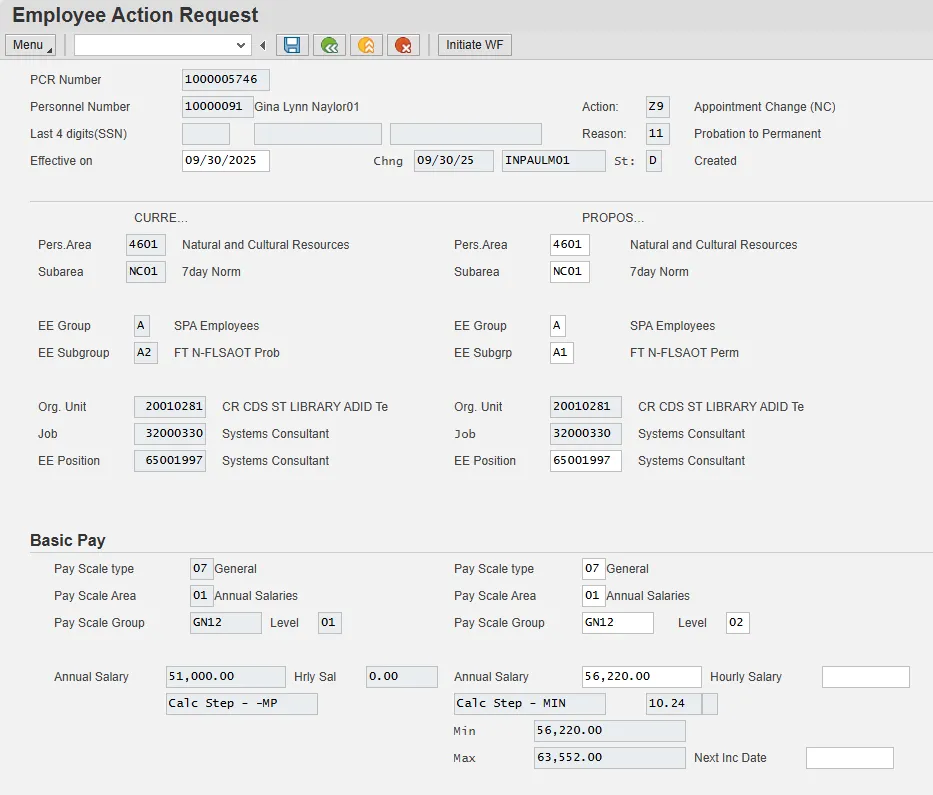
Step 15: Click the Initiate WF button.
Select the Initiate Workflow button to send the Appointment Change Action through the approval process. No changes can be made after the PCR has been submitted for approval, unless the PCR is rejected at any stage and sent back to you (the initiator/requestor).

Step 16: Click Enter or the green check.
Step 17: Click the Back (F3) button.
Step 18: The Initiate Appointment Change Action request is complete.
After Workflow Approvals have been received, proceed with the Complete Appointment Change Action process.
Instructions
Access Transaction:
Via Menu Path: SAP menu ==> Office ==> SBWP – Workplace
Via Transaction Code: SBWP, PA400
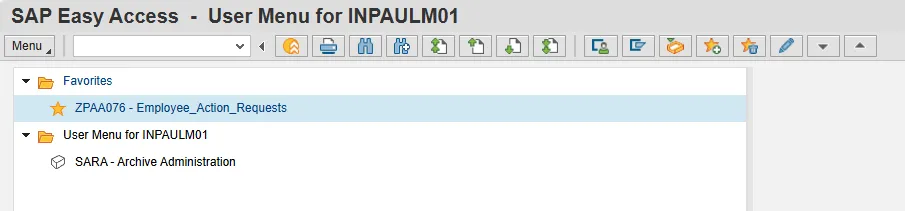
Step 19: Click the SAP Business Workplace (Ctrl+F12) button.
These instructions assume you have initiated the Appointment Change Personnel Change Request (PCR) in workflow already, and you have an approved PCR ready to be processed as an Appointment Change in the system.
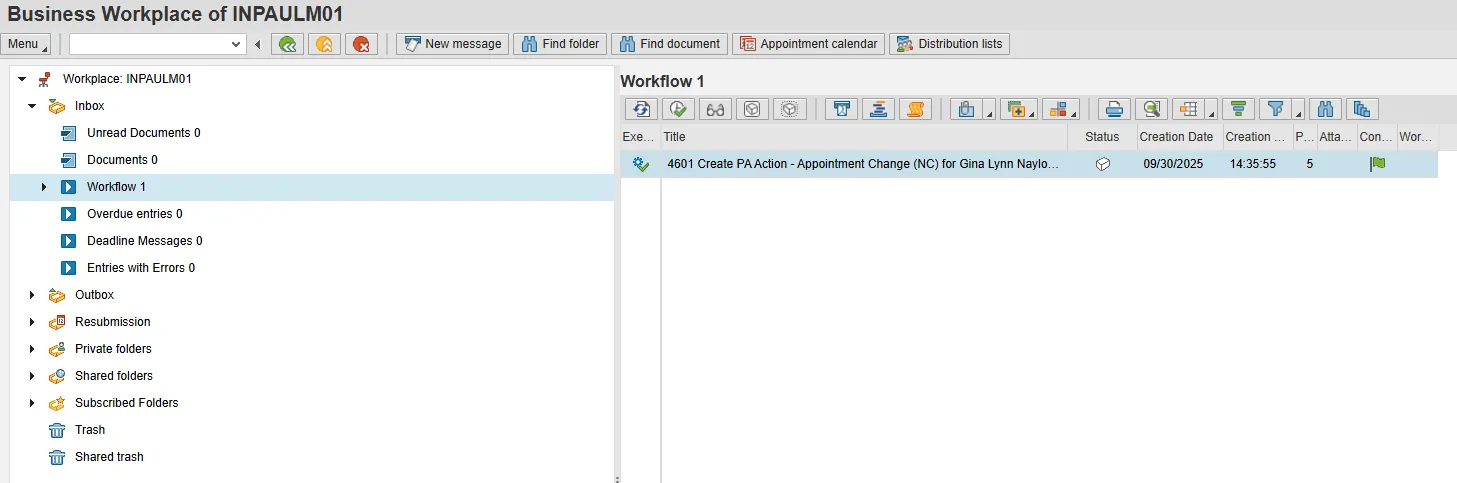
Step 20: Expand Inbox by clicking on the black triangle expand node next to the Inbox folder.
Step 21: Click on the Workflow subfolder.
Step 22: Select the PCR row to highlight it.
You will need to get a copy of the note. It does not carry over to the Action.
Use this resource to see the steps for retrieving a copy of the note: Copying Notes From The PCR to Infotypes.
Step 23: Double-click on the PCR row OR click the Execute (F8) button to begin the action.
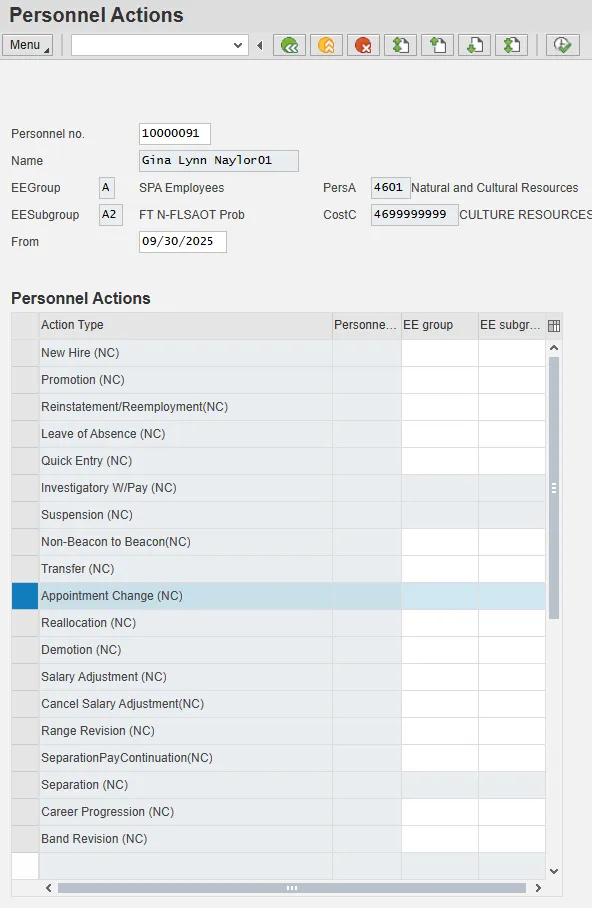
Step 24: Update the following field:
| Field Name | Description | Values |
|---|---|---|
| From | Effective date of the personnel action |
Enter value in From. Example: 09/30/2025 |
Step 25: Highlight the Appointment Change (NC) action type.
Step 26: Click the Execute (F8) button.
Verify this is the individual for whom you need to process the Appointment Change action.
Critical: The effective date is the date the Appointment Change will go into effect and MUST match the date that was submitted as the effective date on the original PCR. The system will not fill this date in - you can find the date on the PCR display from your inbox if you do not know the effective date on the original PCR (not necessarily the date the PCR was submitted, but the date the Appointment Change is to be effective).
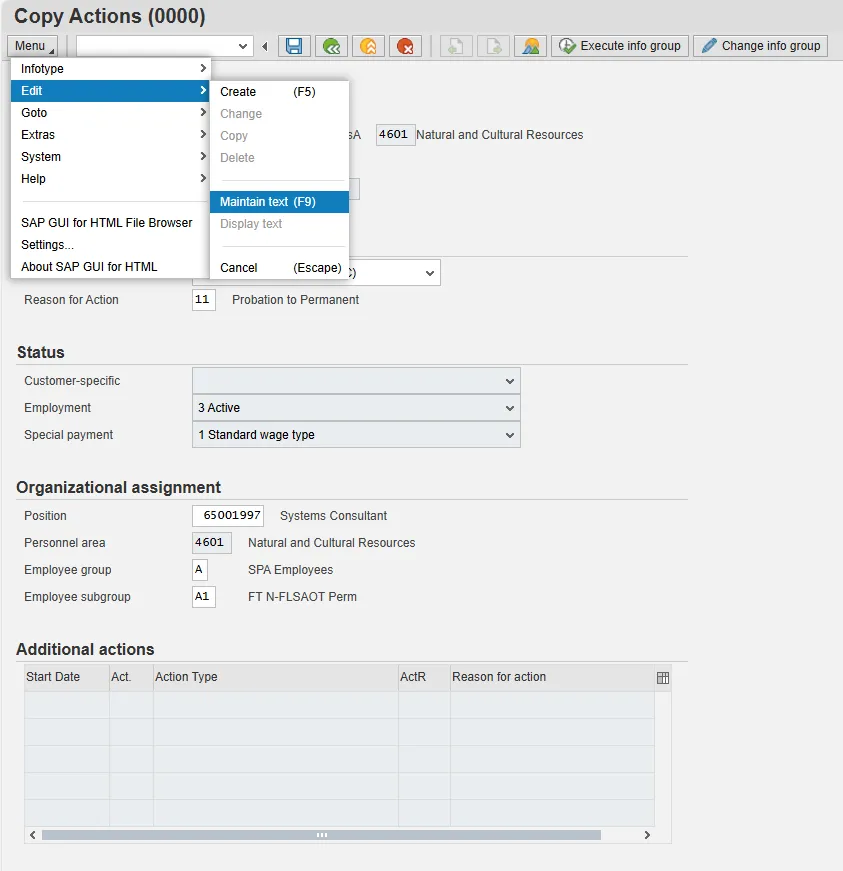
Step 27: On Copy Actions (0000) click Menu >> Edit >> Maintain text to attach a copy of the note to this infotype.
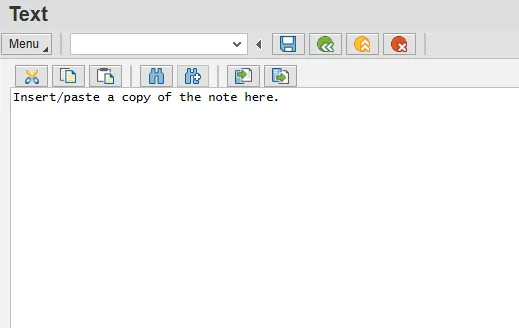
Step 28: Insert a copy of the note in the Text box and click Save.
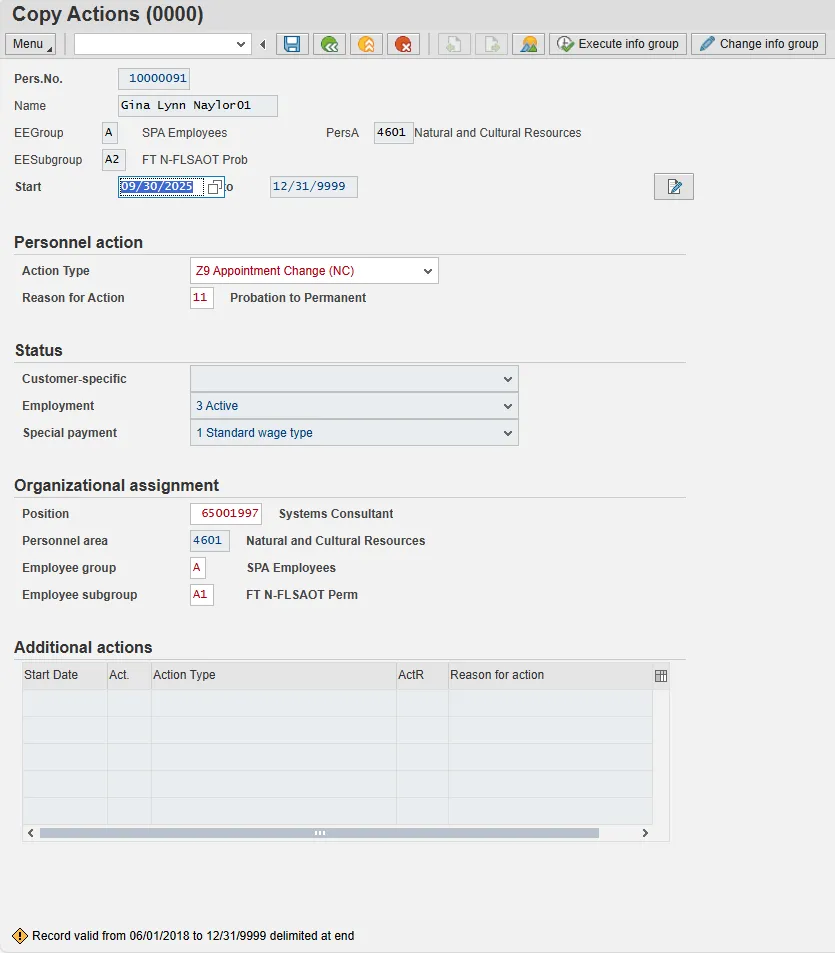
Step 29: Click Enter. You will notice some text turns red and there will be a yellow warning message in the bottom left corner.

The system will provide a yellow warning message informing you the existing record will be delimited. Click Enter to bypass this warning message.
Notice at the top of this screen the title includes the word “Copy.” This action takes the original action and makes a copy of it, delimiting the previous record and saving the new record. The word “Create” in the title indicates that this infotype is being created on this person's record for the first time.
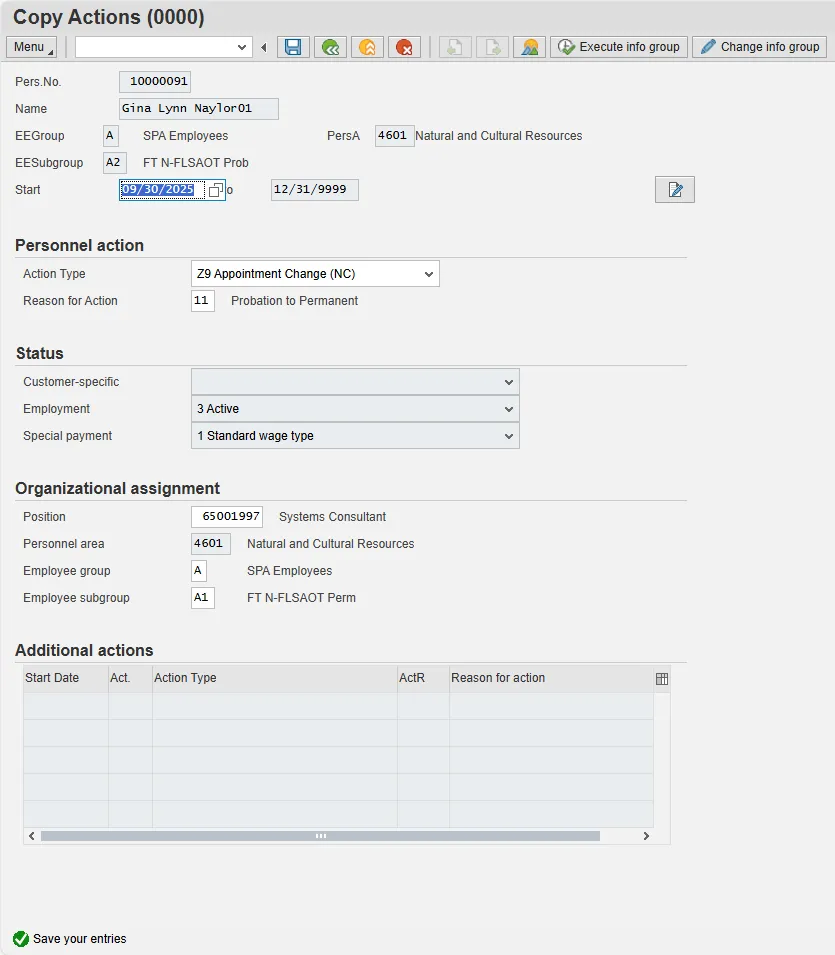
Step 30: Click the Save (Ctrl+S) button.
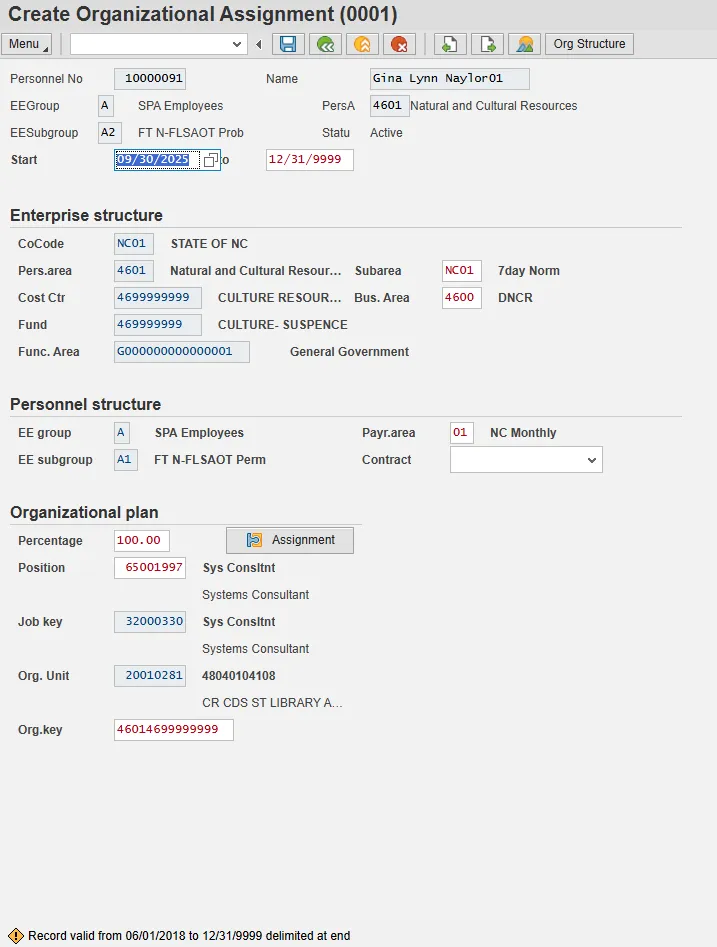
Step 31: Click Enter.
Step 32: Click the Save (Ctrl+S) button.

Adjust their work schedule as appropriate and save the data.
The Work Schedule Rule, Time Mgmt status and Working week defaults from the employee's enterprise structure. It is critical that you review for correctness (including the working week) and change the work schedule as appropriate for the employee if it is different from the one that defaults.
If the individual is part-time, be sure to check the Part-time employee box.
The defaulted work schedule is based on information provided by the various agencies and the Integrated HR-Payroll System team members.
Critical: Subject employees must be positive time. Employment percent should always be 100%.
Step 33: Click Enter.
Step 34: Click the Save (Ctrl+S) button.
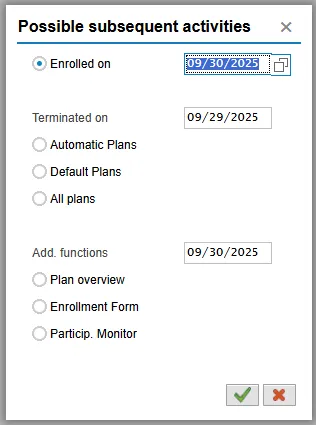
Subsequent activities should be completed only if the employee is transferring to a position in a different retirement system than their current position (for example – going from TSERS to LEORS).
Step 35: Click the Cancel (F12) button.
If you need to process changes to the benefits, click Continue. In this example we will not process changes to benefits and will click Cancel.
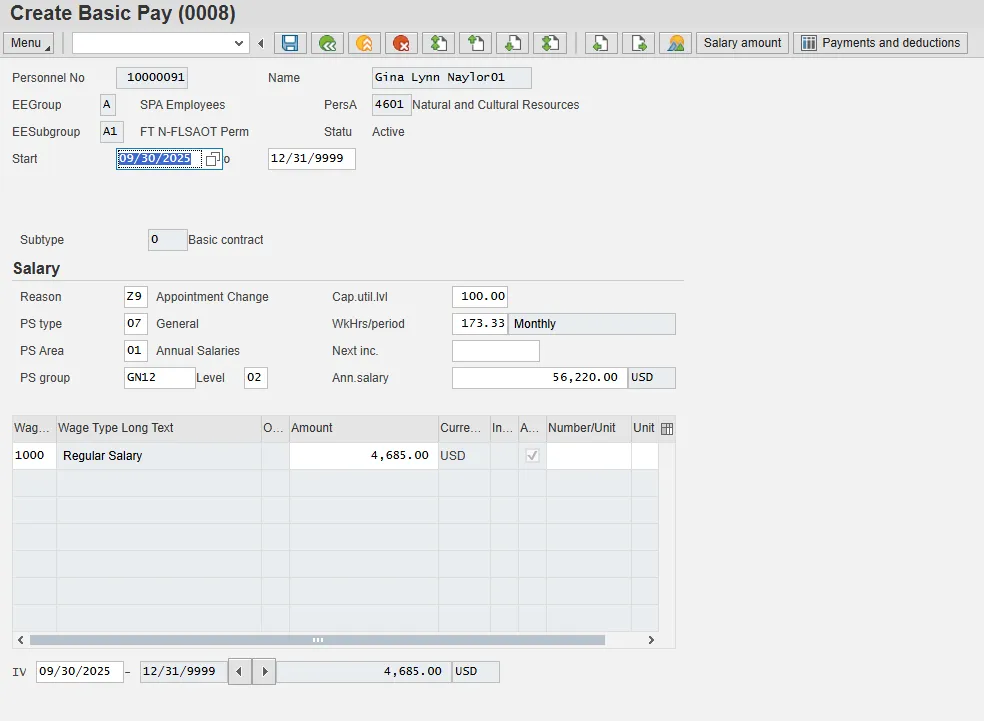
Step 36: Update the following field:
| Field Name | Description | Values |
|---|---|---|
| Reason | Reason for the action, such as Appointment Change |
Enter value in Reason. Example: Z9 |
Step 37: Click Enter button.
The pay scale values (pay scale type, pay scale area, pay scale group and level) have been designed to default based on the rules assigned to the employee's position. If the pay scale values do not default, please contact BEST Shared Services or your BEST HR Specialist.
Enter the Reason Appointment Change [Z9] and click Enter to validate the data. Notice the Annual Salary field has retrieved the amount submitted via workflow (or the hourly field if appropriate).
You will enter the hourly rate in the amount field manually; hit enter and the annual salary automatically calculates.
The Cap. Util. lvl always should be 100%. The Annual Salary should be the amount you are paying the employee. If at 40 hrs/wk EE was paid $80,000 and now EE is only working 20 hrs/wk, the salary entered will be $40,000. You are paying 100% of $40,000.
Step 38: Click the Save (Ctrl+S) button.
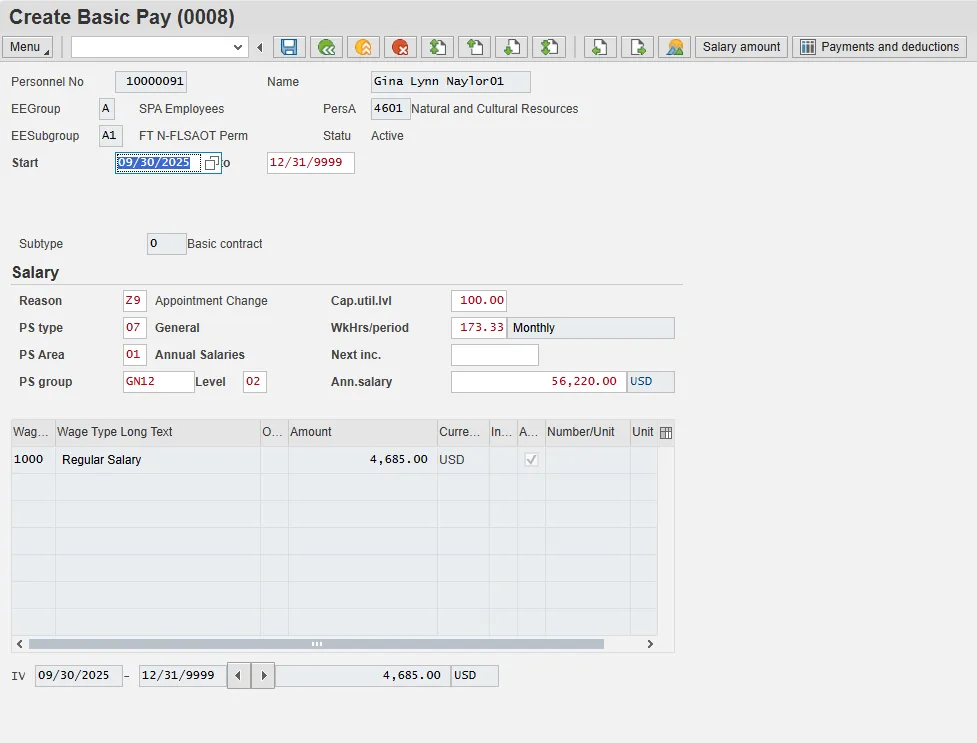
Some text turns red and a yellow message appears in the lower left corner indicating Record valid from 07/01/2019 to 12/31/9999 delimited at end.

Step 39: Click Enter to bypass the message.
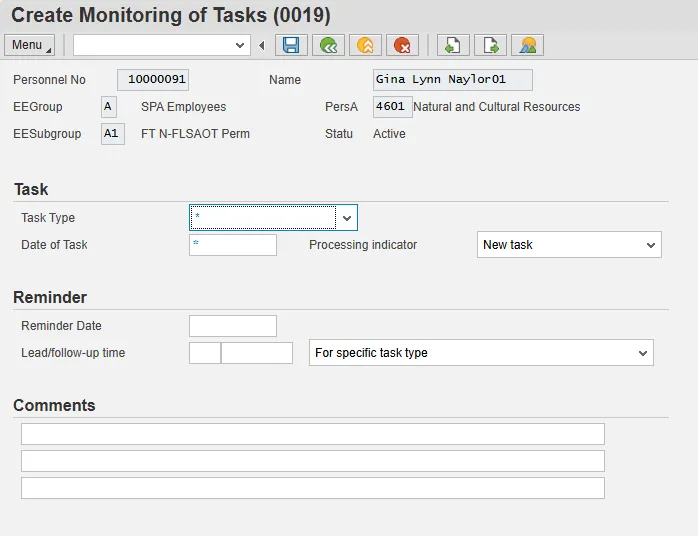
Step 40: Click the Next record (Shift+F7) button to bypass Create Monitoring of Tasks (0019).

Step 41: Click Enter.
Step 42: Click the Save (Ctrl+S) button.
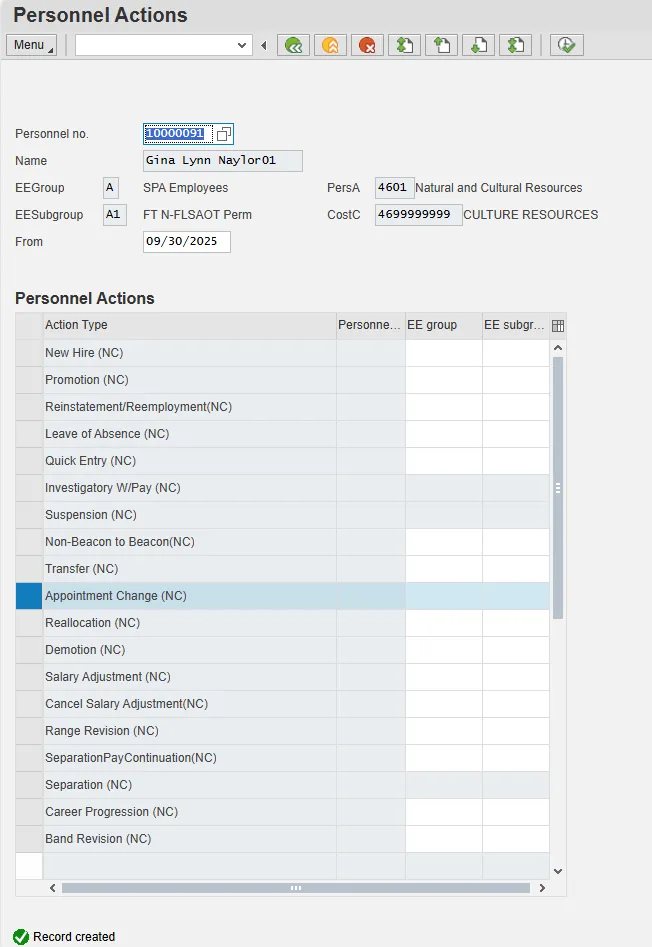
Step 43: Click the Back (F3) button.
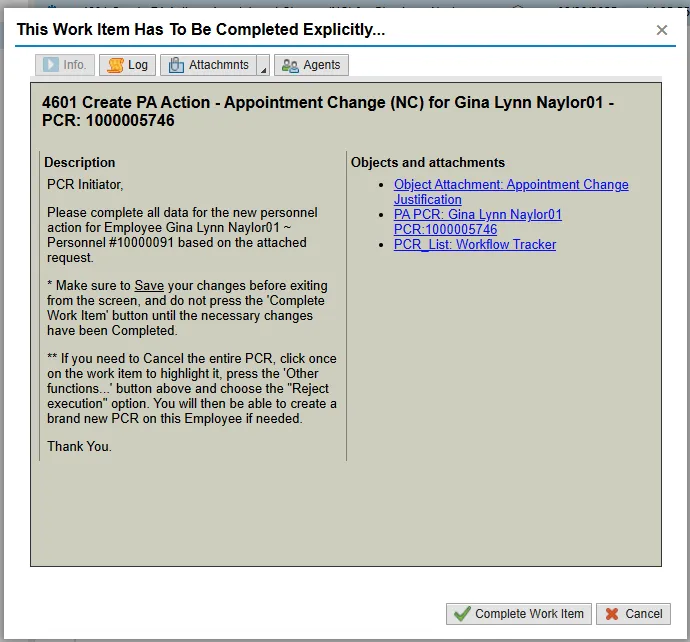
Step 44: Click the Complete Work Item button.
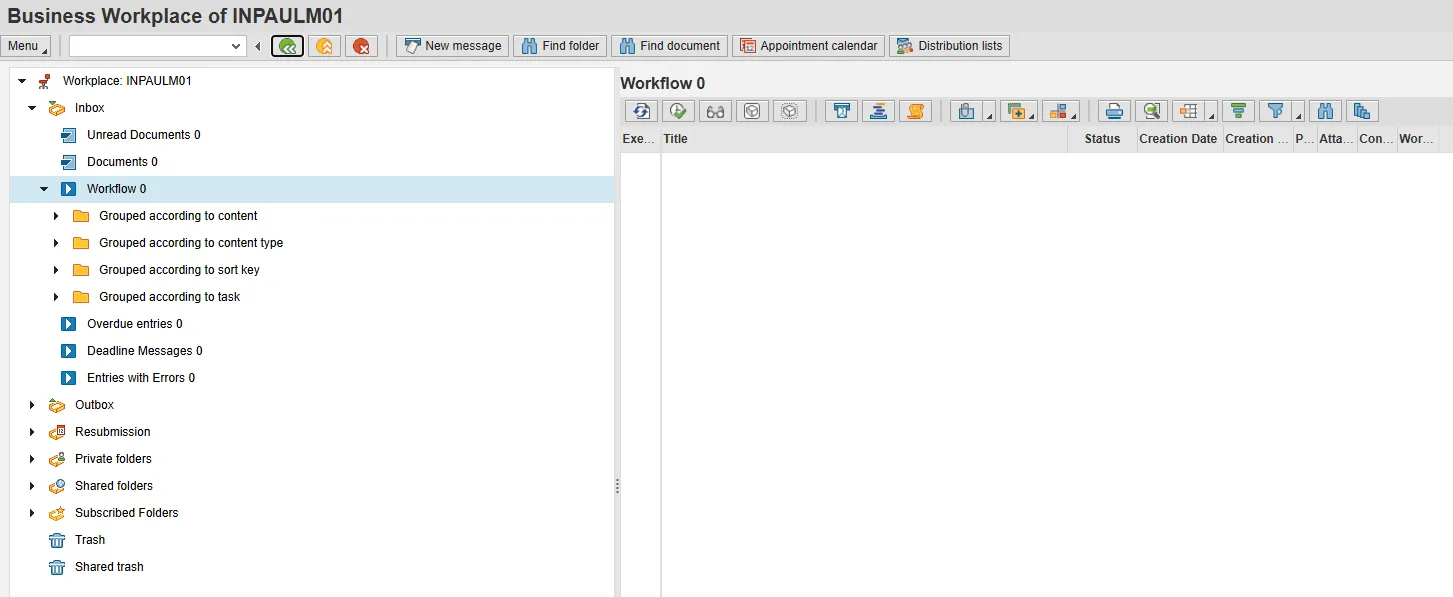
Step 45: Click the Back (F3) button.
The Appointment Change Action is complete, but we recommend reviewing via PA20 all infotypes that have been processed.